
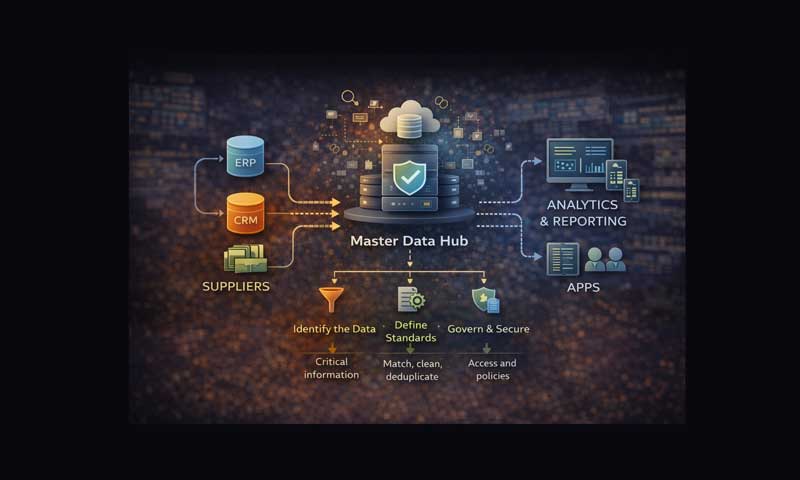
In every large organization, there is a fundamental problem: the same data is stored in different systems in different formats. A client in CRM is “Progress LLC”, in accounting — “Progress L.L.C.”, in the warehouse system — “LLC Progress”. One client, three records, no certainty that the data is current.
Master Data Management (MDM) is a discipline and set of technologies that solves this problem once and for all.
What Is Master Data?
Master data refers to key business entities used across multiple systems simultaneously: customers, suppliers, products, employees, organizational structure, reference data. This is not transactional data (invoices, orders) but the “core” around which all business processes are built.
Signs You Need MDM
Your managers spend time searching for the “correct” version of data. Reports from different systems show different numbers for the same period. You cannot answer a simple question: how many active clients do you have? New systems require lengthy and painful reference data migration during implementation.
How to Build MDM: A Step-by-Step Approach
Stage one — define the domain. Start with one category of master data: typically customers or products. Don’t try to cover everything at once.
Stage two — data profiling. Analysis of existing data across all systems: duplicates, gaps, inconsistencies, outdated records.
Stage three — defining the “golden record.” For each entity, determine which system is the source of truth for each attribute.
Stage four — implementation. Deploying an MDM platform, configuring matching and merging rules, building integrations with sources.
Stage five — governance. Defining data steward roles, verification and enrichment processes, quality KPIs.
Results
Organizations that have implemented MDM report a 60-70% reduction in report preparation time, an 80% decrease in document errors, and 2-3x faster implementation of new systems.