
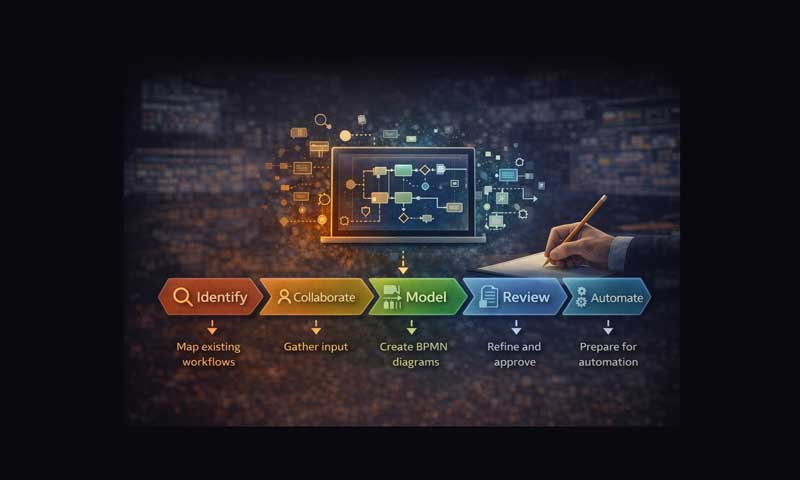
Most automation failures happen not because of bad technology, but because nobody described the process before starting to automate it. The team begins coding a workflow without understanding all the branches, exceptions, and responsible parties. The result — a system that automates chaos.
What Is BPMN?
Business Process Model and Notation is a standardized graphical notation for describing business processes. BPMN allows you to describe a process so that it is equally understood by both business analysts and developers.
The key advantage of BPMN is that it’s a language both sides understand: business sees their process, and IT sees a technical specification for implementation.
Key BPMN Elements
Event — a start, end, or intermediate event in a process. For example, “Request received” or “Approval deadline expired.”
Task — a unit of work performed by a specific participant or system. For example, “Check document completeness.”
Gateway — a decision point. For example, “Amount exceeds 100,000?” — yes/no, and the process follows different paths.
Flow — arrows connecting elements and showing the execution sequence.
How We Apply BPMN in Projects
In the first stage, we conduct a series of interviews with process participants — each describes their part. It often turns out that different people have different understandings of the same process.
In the second stage, an AS-IS model is created — “how it works now.” This is a mirror of reality, including all inefficiencies and workarounds.
In the third stage, the TO-BE model is designed — “how it should be.” Here, bottlenecks are eliminated, routine operations are automated, and control points are added.
Only after the TO-BE is approved does technical implementation begin. This avoids expensive reworks and ensures that automation meets real business needs.