
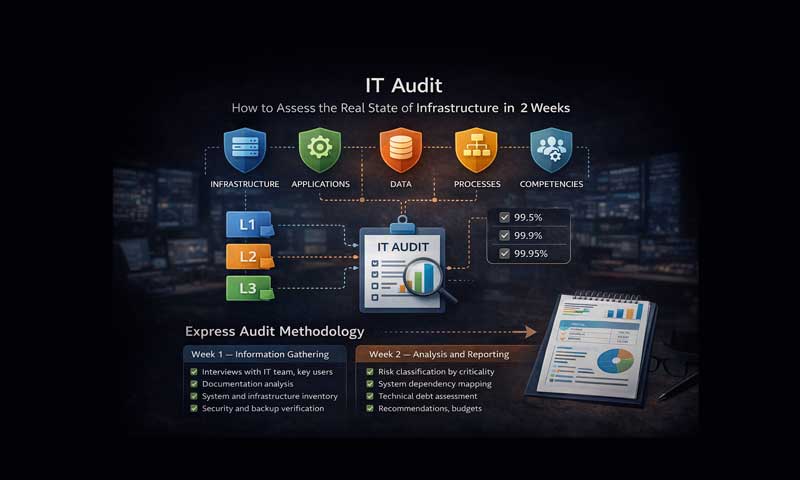
Most organizations don’t know the real state of their IT infrastructure. There’s a general feeling that “something isn’t working right,” but without a systematic audit, it’s impossible to pinpoint exactly where the problems are and which ones are critical.
What an IT Audit Covers
A comprehensive IT audit spans several layers: infrastructure (servers, networks, security), application systems (ERP, CRM, EDMS and their status), data (quality, integrity, backup), processes (how IT serves the business, SLA, incident management), competencies (whether the team is sufficient to support existing and planned systems).
Express Audit Methodology
A full audit can take months. But for making initial decisions, a 2-week express audit is sufficient.
Week one — information gathering: interviews with the IT team and key users, documentation analysis, system and infrastructure inventory, security and backup verification.
Week two — analysis and reporting: risk classification by criticality, system dependency mapping, technical debt assessment, recommendations with priorities and approximate budgets.
What You Get
The result of an IT audit is not just a document describing problems. It’s a roadmap: what to fix immediately (critical risks), what to plan for the quarter, and what to include in the strategic modernization plan. Each recommendation has a priority, approximate budget, and expected impact.