
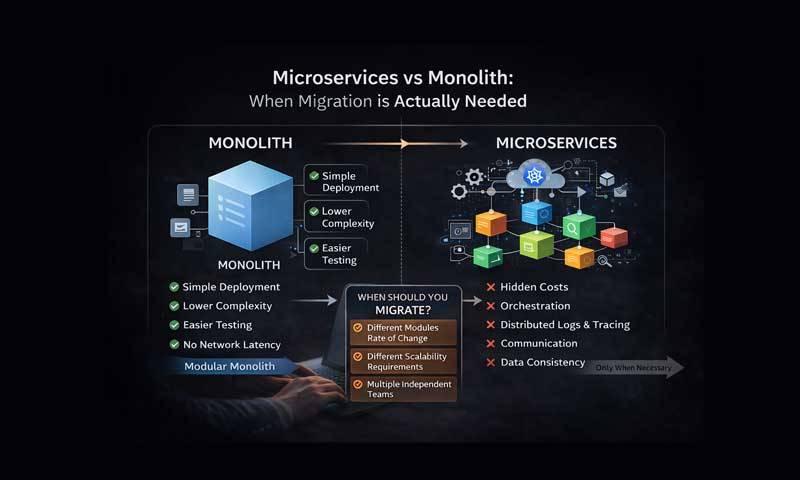
“Let’s move to microservices” is one of the most common phrases in modern IT discussions. By 2026, microservice architecture has become the de facto standard for large-scale digital platforms — but that does not mean it fits every case.
Microservices are not a universal solution. Without a clear understanding of business needs, their adoption often leads to increased complexity, higher costs, and reduced system manageability.
The key question is not which architecture to choose, but which model best aligns with your product’s maturity, team structure, and business objectives.
Monolith as a practical baseline
Despite the popularity of microservices, monolithic architecture remains highly relevant. In fact, in 2026 many companies are rethinking monoliths — but in a more structured and modular way.
- simpler deployment and maintenance;
- no network latency between components;
- unified data model;
- predictable system behavior;
- lower DevOps requirements.
For small teams, internal systems, or products with relatively stable logic, a monolith is often more efficient and cost-effective than a distributed architecture.
A monolith is not a limitation — it is a controlled environment that enables fast development without unnecessary complexity.
When microservices actually make sense
Microservices become relevant only when the system reaches a certain level of scale and complexity.
- different parts of the system evolve at different speeds;
- specific components require independent scaling;
- multiple autonomous teams work on the product;
- independent delivery pipelines are required;
- the system operates under high or uneven load.
In such scenarios, microservices increase flexibility, isolate changes, and accelerate product development.
Architecture reality in 2026
Modern systems have become significantly more complex. They operate in hybrid environments, integrate with dozens of external services, and increasingly include AI-driven components.
Today, microservices almost always imply containerization, Kubernetes orchestration, API gateways, distributed monitoring, advanced security models, and deep integration with cloud platforms.
This increases flexibility — but also raises the bar for architecture design and team expertise.
Hidden costs and operational complexity
The most common mistake is evaluating development costs without considering long-term system operation.
- complex inter-service communication;
- data consistency issues;
- need for distributed tracing;
- more difficult system-wide testing;
- increased DevOps workload;
- higher security requirements.
As a result, systems become more flexible — but also more expensive to maintain and harder to manage.
Approach of Data Management IG LLC
In practice, the biggest mistake is starting transformation from technology selection instead of business analysis.
- analysis of the current architecture;
- identification of critical components;
- evaluation of load and change dynamics;
- assessment of team structure and development processes.
Based on this, a development strategy is defined that avoids unnecessary complexity while maintaining system control.
The monolith remains where it is efficient, while microservices are introduced only where they provide real business value.
Engineering implementation
Data Management IG LLC provides not only architectural planning but also practical implementation: infrastructure design, DevOps setup, service integration, and stable system operation in production environments.
Modular monolith as a practical strategy
In most cases, the optimal starting point is a modular monolith — a system with clearly defined boundaries between components.
- controlled complexity;
- future-ready architecture;
- lower infrastructure costs;
- reduced transformation risks.
If a module requires independent scaling or evolution, it can later be extracted into a microservice without redesigning the entire system.
A strong architecture is not about choosing between monoliths and microservices — it is about finding the right balance between flexibility, control, and economic efficiency. Data Management IG LLC helps build systems that evolve with the business instead of complicating it.