
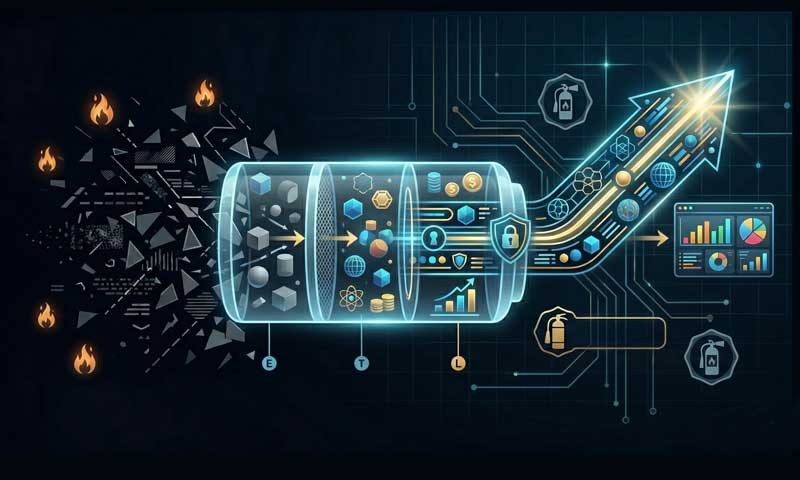
Any organization working with multiple data sources eventually faces the need for ETL — Extract, Transform, Load.
This is the process of extracting data from various systems, transforming it, and loading it into a target environment.
In reality, this is where most data problems begin: pipelines break, data becomes inconsistent, reports are delayed, and teams spend more time fixing issues than analyzing data.
The Problem
In most organizations, ETL processes are built in an ad hoc manner:
- integrations are created per task, without a unified architecture;
- data quality is not controlled;
- source changes break pipelines;
- execution visibility is limited;
- scaling leads to performance degradation.
As a result, businesses lose trust in their data.
Typical ETL Scenarios
- BI data consolidation: combining ERP, CRM, and warehouse systems into a unified analytics layer;
- System migration: transferring data with structural transformation;
- Master data synchronization: aligning customers, products, and entities across systems.
ETL vs ELT
Traditional ETL transforms data before loading.
The modern ELT approach loads raw data first and transforms it inside the data warehouse.
- ETL — suitable for controlled environments;
- ELT — ideal for large-scale and cloud-based architectures.
The right choice depends on business and architectural needs.
Common ETL Challenges
- Source changes: schema updates break pipelines;
- Data growth: processes slow down dramatically;
- Data errors: a single bad record stops execution;
- Lack of monitoring: stale data goes unnoticed for days.
The Data Management IG Approach
We design ETL/ELT pipelines as reliable data infrastructure, not just scripts.
Our Approach
- unified data processing architecture;
- modular, scalable pipelines;
- decoupled transformation logic;
- modern orchestration tools;
- built-in data quality layer.
What We Implement
- Idempotency: safe re-execution of pipelines;
- Logging: full traceability at every stage;
- Error handling: fault tolerance without full pipeline failure;
- Monitoring: execution time and volume tracking;
- Alerting: automated failure notifications.
Business Outcomes
- stable and predictable data processing;
- reduced downtime and manual intervention;
- up-to-date data for analytics;
- scalable performance;
- increased trust in data.
How Data Management IG Helps
Data Management IG builds ETL/ELT as the foundation of a data-driven business — from architecture design to operational support.
We don’t just move data — we ensure it is reliable, consistent, and ready for use.