
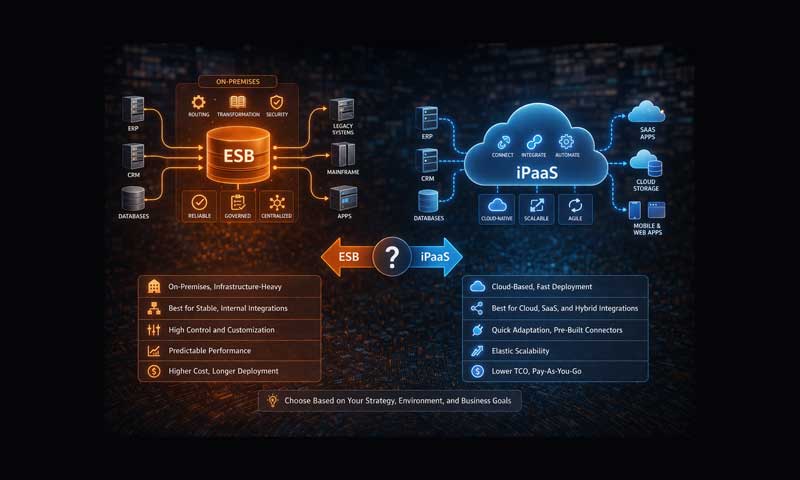
When an organization decides to build a centralized integration layer, a key architectural question arises: ESB (Enterprise Service Bus) or iPaaS (Integration Platform as a Service)? Both approaches solve the same problem — ensuring data exchange between systems — but they do it in fundamentally different ways.
ESB: The Classic of Enterprise Integration
Enterprise Service Bus is a centralized message bus deployed on the organization’s own infrastructure. ESB receives, transforms, and routes messages between systems according to defined rules.
ESB advantages: full control over infrastructure, ability to operate without internet, compliance with security requirements for the public sector, deep customization of routing rules.
Disadvantages: high initial investment, need for specialists to maintain, difficulty scaling, risk of creating a “single point of failure.”
iPaaS: The Cloud Approach
iPaaS is a cloud platform that provides integration capabilities as a service. Instead of deploying your own infrastructure, you use ready-made connectors and visual builders to create integrations.
iPaaS advantages: quick start, low entry barrier, automatic scaling, ready-made connectors to popular services, less need for narrow specialists.
Disadvantages: vendor dependency, customization limitations, security concerns when working with sensitive data, potentially high costs at large volumes.
How to Choose?
For the public sector and organizations with strict data security requirements, ESB remains the optimal choice. Data stays within the perimeter, and the organization has full control.
For commercial companies working primarily with cloud SaaS solutions, iPaaS can be a more effective choice — less capital expenditure, faster launch.
Most often, a hybrid approach is optimal: ESB for critical internal integrations and iPaaS for external services.