
When a system goes down on Friday evening and the IT department responds “we’ll look at it Monday” — that’s not just inconvenience. For critical business systems, every hour of downtime means real financial losses, missed deadlines, and eroded trust.
What Is SLA and Why You Need It
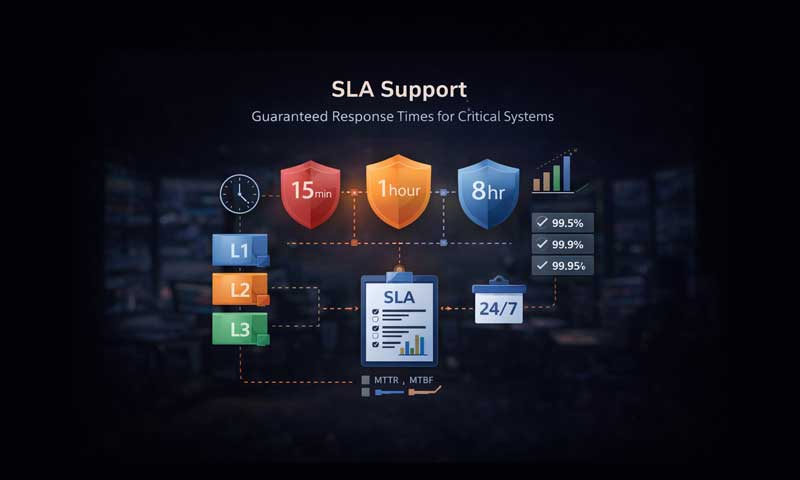
A Service Level Agreement is a formalized agreement that defines: incident response time (from 15 minutes for critical to 8 hours for low-priority), resolution time (from 2 hours to 5 business days), system availability (99.5%, 99.9%, 99.95%), support schedule (8/5, 12/7, 24/7).
Support Tiers
L1 — first line. Receiving requests, classification, resolving common issues using the knowledge base. Response time — 15-30 minutes.
L2 — second line. Diagnosing and resolving complex technical problems. Response time — 1-2 hours.
L3 — third line. Architectural changes, enhancements, code-level problem solving. Engaged through escalation.
Metrics and Reporting
An SLA without measurement is just paper. Key metrics: MTTR (Mean Time to Repair), MTBF (Mean Time Between Failures), SLA compliance percentage for the period, number of escalations.
These metrics should be transparent to the client — a monthly report with trend analysis and an improvement plan.