
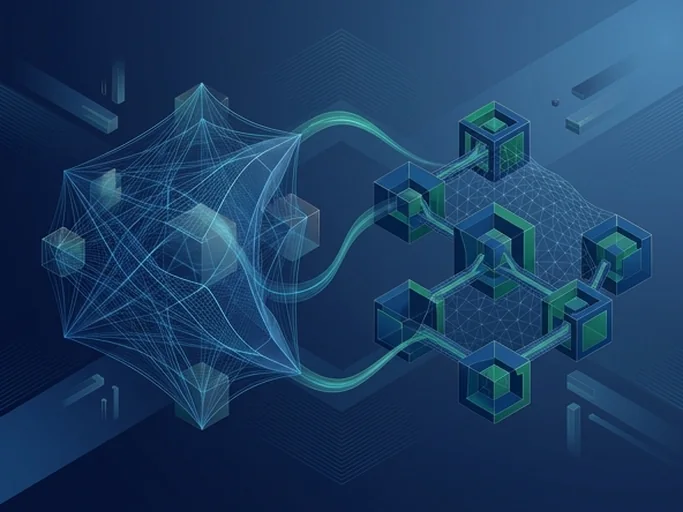
Challenges of modern data architectures: Why traditional approaches no longer work
The increasing demand for rapid access to high-quality data for business intelligence and AI/ML necessitates new approaches to data architecture. Traditional monolithic data warehouses often struggle with data fragmentation, slow access, and scalability complexities. This leads to delays in decision-making and reduces the effectiveness of innovative initiatives.
Data Mesh: Decentralization and domain-oriented data ownership
Data Mesh is an architectural approach that aims to create business-oriented data products in environments with distributed data management and responsibility for their governance source[3]. The Data Mesh concept, developed by Zhamak Dehghani, is based on four principles: decentralized, domain-oriented data ownership; data as a product; self-serve data infrastructure as a platform; and federated computational governance source[1]. This approach shifts data responsibility directly to the business domains that generate and consume it, treating data as full-fledged products with their own lifecycle, quality, and documentation.
Data Fabric: An integrated platform for unified access
Data Fabric is a modern data architecture designed to democratize data access across an organization, utilizing intelligent and automated systems to eliminate silos and optimize data management at scale source[2]. According to Gartner, Data Fabric is an emerging data management and integration design concept that uses metadata to automate data management tasks and eliminate manual integration efforts source[8]. Key technological capabilities of Data Fabric include data catalogs, data integration, data governance and security, self-service data access, data virtualization, federated active metadata, and machine learning source[6].
Data Mesh vs. Data Fabric: A comparative analysis for strategic choice
Unlike Data Mesh, which focuses on how data responsibility is distributed, Data Fabric focuses on how data is connected, managed, and made usable across the enterprise source[6]. Data Fabric is most effective when the business requires consistent, real-time access to data distributed across multiple systems, clouds, and applications, without creating new data repositories source[6]. Both approaches can complement each other, where Data Fabric can provide the technical foundation for integration and management, and Data Mesh can define decentralized ownership and responsibility source[6].
Selection criteria: Which architecture suits your enterprise?
The choice between Data Mesh and Data Fabric depends on many factors, including organizational culture, existing infrastructure, and strategic priorities. For organizations with a high degree of decentralization and a desire to grant domains greater autonomy, Data Mesh may be more appealing. Conversely, for enterprises striving for centralized data governance and unified access through a single technological platform, Data Fabric may be the optimal solution.
How to use the selection table:
Use this table to evaluate the suitability of each architecture for your needs. Analyze each criterion and determine which architecture best aligns with your organization's current maturity, culture, and strategic goals. For example, if your organization already has strong, independent business domains ready to take ownership of data, Data Mesh might be a more natural fit. If the priority is to quickly create a unified virtual data layer with minimal interference to existing systems, Data Fabric might be more effective.
| Criterion | Data Mesh | Data Fabric |
|---|---|---|
| Data Ownership | Decentralized, domain-oriented | Centralized, platform-managed |
| Data Governance | Federated, domain teams | Centralized, automated |
| Technological Implementation | Self-serve data infrastructure as a platform | Integrated platform with AI/ML-driven automation, knowledge graph, active metadata |
| Organizational Implications | Requires cultural change, high domain autonomy | Can be implemented on top of existing systems, fewer organizational changes |
| Implementation Complexity | High (organizational and cultural transformation) | Moderate (technological integration) |
| Scalability | Horizontal, by adding domains | Horizontal and vertical, via the platform |
| Flexibility | High (domains can adapt quickly) | High (fast access to data from various sources) |
| Primary Focus | Data as a product, decentralization of responsibility | Unified data access, integration, and automation |
Choosing the optimal data architecture is critical for ensuring enterprise competitiveness and innovative development. DMIG, as a company specializing in system integration, data management, and process automation, understands the importance of a flexible and scalable data ecosystem. Effective selection and implementation of data architecture are fundamental for successful digital transformation and efficient data utilization in the solutions we provide.
Making a decision between Data Mesh and Data Fabric requires a deep understanding of both technological capabilities and organizational readiness. There is no one-size-fits-all solution, and success depends on a thorough analysis of your enterprise's unique needs and context.
Перелік джерел

Author