
Data Governance

Federated data quality governance: Balancing control and autonomy
Discover how to establish and maintain a federated data quality governance model that combines centralized standards with domain autonomy in distributed architectures. This approach is critical for preventing data fragmentation and ensuring data reliability.

Data consistency in distributed systems: Choosing a model for business processes
Selecting a data consistency model in distributed systems – from strong to eventual – is a key architectural trade-off affecting operational reliability and the quality of business decisions. This decision requires understanding the impact on availability, performance, and latency for critical business processes.

Technical compliance for data sharing agreements
Ensuring compliance when exchanging data with external partners demands translating legal obligations into concrete technical controls within integrated systems. This includes implementing granular access control, data masking, and secure API gateways.

AI/ML model drift: How data quality impacts business outcomes
Unmonitored AI/ML model drift, driven by real-time data quality degradation, transforms a once-calibrated model into an operational risk. This leads to reduced performance and direct financial losses, necessitating comprehensive monitoring strategies and automated remediation.

Shadow integrations: Reclaiming control over the IT landscape
Discover how to identify, assess, and integrate uncontrolled 'shadow' IT integrations and their fragmented data into a managed enterprise architecture. This will help eliminate security, compliance, and operational risks caused by decentralized business unit decisions.

Accessing sensitive data for AI/ML: Balancing innovation and compliance
Ukrainian companies face a critical challenge: how to utilize sensitive data for AI/ML while adhering to data protection laws. This article provides practical strategies and architectural approaches to resolve the conflict between innovation and compliance.

Access and data security management in hybrid integrations
The increasing complexity of hybrid integration environments compels architects and IT infrastructure leaders to choose between centralized and federated access management models to ensure compliance and mitigate risks.

Managing Decentralized Automation: Controlling Risks and Data Integrity
The rise of RPA and low-code solutions creates 'automation chaos' and 'shadow bots,' demanding strategies from IT leaders to ensure security, data quality, and operational resilience. An effective governance model blends business unit flexibility with centralized IT control.

Balancing compliance and costs in multi-cloud data archiving
Managing data archiving and retention in multi-cloud and hybrid environments presents significant challenges for enterprises. This article explores how to develop and implement a consistent and compliant strategy that optimizes costs and ensures data availability.

Where to validate data in complex integration flows?
Optimal placement of data quality checks in an integration architecture is key to minimizing error correction costs and ensuring data reliability. This decision requires considering data volumes, latency requirements, and implementation complexity.
Multi-cloud data integration: A unified data fabric for the enterprise
Building a unified data fabric across hybrid and multi-cloud environments is critical for operational continuity and advanced analytics. This requires a balanced approach to data management, security, and performance.

Data Lakehouse or Data Mesh: Choosing the right architecture for compliance in Ukraine
Choosing the optimal data architecture (Data Lakehouse vs. Data Mesh) is crucial for Ukrainian businesses, considering national legislation and GDPR requirements for data protection and sovereignty. This decision impacts flexibility, scalability, and the ability to adhere to regulatory norms.

Balancing cost and resilience in hybrid data protection architecture
Choosing the optimal data protection architecture in hybrid and multi-cloud environments demands a strategic approach that considers RTO/RPO, cyber threats, data sovereignty, and cost optimization. This choice is critical for business continuity and compliance amidst an increasingly complex IT landscape.
Data contracts: Ensuring data product reliability in distributed architectures
The increasing complexity of enterprise data demands new approaches to quality and reliability management. Data contracts are a key mechanism for ensuring data consistency and trust in decentralized systems.

Accuracy and compliance in enterprise IDP solutions
Data leaders and digital transformers face the challenge of balancing the speed of automated document processing with the critical need for high data accuracy and regulatory compliance. This article offers strategies and a checklist for selecting IDP solutions that meet these requirements.

End-to-end Data Lineage for compliance and audit
Implementing automated, end-to-end Data Lineage is critical for meeting escalating regulatory requirements and enabling effective internal audits. This solution demands significant investment but mitigates high risks and costs associated with non-compliance.

Data residency and sovereignty: Cloud compliance for large enterprises
Increasing regulatory pressure and geopolitical factors make data residency and sovereignty critical for any enterprise handling sensitive information or operating in international markets. This article offers practical architectural solutions for CIOs/CTOs.

Data Mesh or Data Fabric: Choosing an architecture for the scalable enterprise
Modern enterprises face the challenge of effectively managing growing data volumes. The choice between Data Mesh and Data Fabric has strategic implications for the flexibility and scalability of the data ecosystem.
Choosing data architecture for real-time AI/ML
Selecting the optimal data architecture (batch, streaming, or hybrid) is critical for supporting real-time AI/ML model training and inference. This decision balances latency, cost, and system complexity.

Managing Data Quality Rules: Exceptions and the Cost of Errors
Architecting Data Quality Rules as a product involves defining clear ownership, establishing an efficient workflow for exceptions, and implementing a methodology for measuring economic impact. This approach ensures data integrity and optimizes costs.

EDMS migration without document flow interruption: a parallel operation plan
Public sector IT infrastructure leaders face the challenge of EDMS migration while maintaining business continuity and the legal validity of document flow. This article proposes an architectural solution for parallel operation, analyzing key criteria, risks, and operational implications.

Process Mining: Event log suitability for automation
Assessing event logs for Process Mining requires verifying the presence of unique case identifiers, precise timestamps, and detailed activity attributes. This is critical for reliable process modeling and well-founded architectural decisions regarding automation.
MDM without centralization: Defining master system boundaries
Defining the boundaries of master systems is a critical architectural decision for successful MDM. This approach helps avoid excessive centralization and ensures data quality.
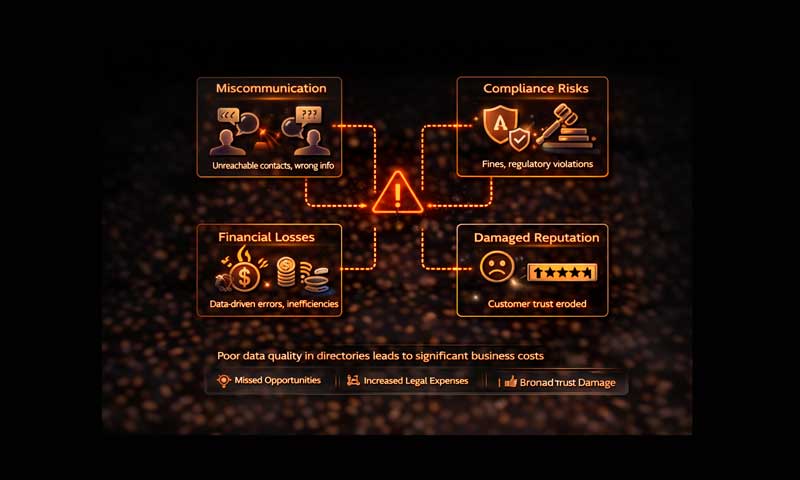
Data Quality: The Real Cost of Errors in Corporate Directories
Analyzing the real cost of poor data quality for business: error types, quality metrics, and the 1-10-100 rule.
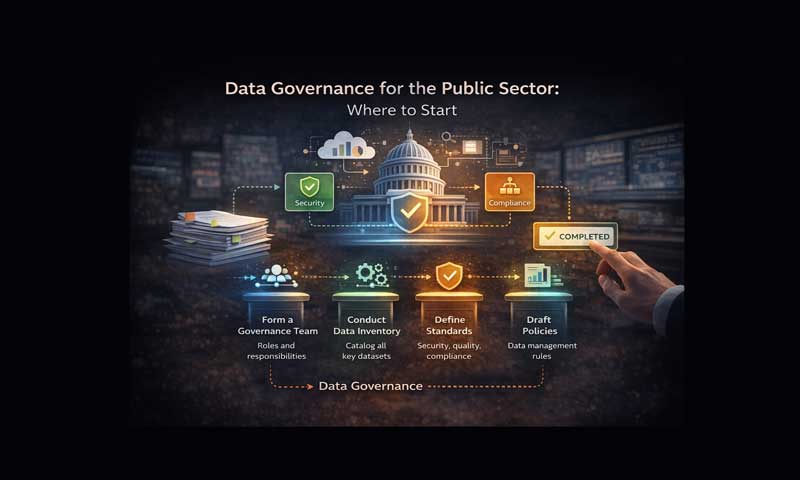
Data Governance for the Public Sector: Where to Start
A practical framework for implementing Data Governance in government organizations: from strategy to operational level.
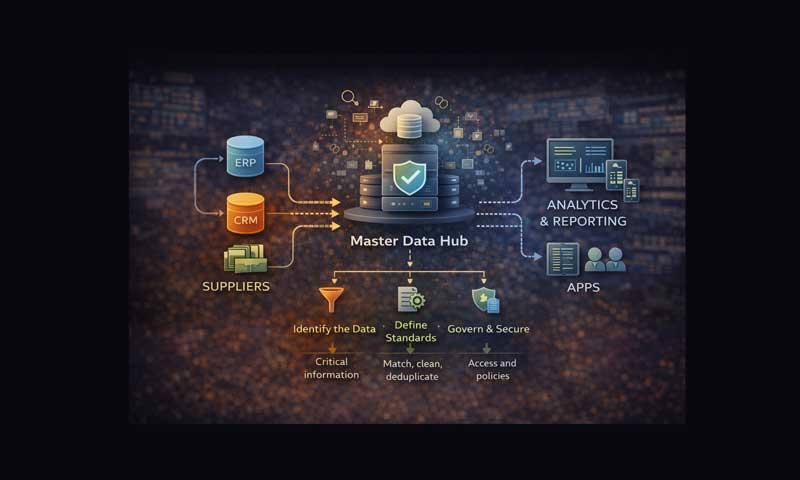
MDM: How to Build a Single Source of Truth in Your Organization
A step-by-step approach to implementing Master Data Management: from data profiling to governance framework.
Yurii Syvytskyi and Serhii Balashuk Showed the Capabilities of Next-Generation Document Management
On June 11, 2024, at the offline Intecracy Solution Day dedicated to ECM innovation, Yurii Syvytskyi and Serhii Balashuk showed the capabilities of next-generation document management: automatic classification, routing and processing of documents with AI on the Nectain Platform.
Serhii Balashuk Presented a System for Managing Enterprise Reference and Master Data
On August 8, 2023, during an Intecracy Expert Webinar, Serhii Balashuk presented a system for managing enterprise reference and master data, focusing on MDM, deduplication and a single source of truth.
Yurii Syvytskyi Spoke About Corporate Document Lifecycle Automation
On March 14, 2023, the Intecracy Customer Workshop was held in a mixed format, where Yurii Syvytskyi spoke about corporate document lifecycle automation using Megapolis.DocNet.